The quiet capitalWhy Rabat rewards a private guide
Rabat does not announce itself the way Marrakech or Fes do. It is calmer, more orderly, and easy to underestimate on a quick pass-through. With a licensed guide and a private driver, that changes: instead of navigating logistics, you spend your time understanding what you are looking at, from royal architecture to a UNESCO-listed urban landscape recognized in 2012. It is a natural stop when you are mapping out a route through the country's great historic centers, and it sits comfortably in our itineraries covering the imperial cities of Morocco.
The city carries an unusually long memory. Long before it became the seat of the modern monarchy, this bend in the river held a Roman-era settlement and, later, a medieval Almohad stronghold whose great mosque was never finished. To place Rabat within the sweep of dynasties that built it, our companion nearby city, Casablanca, is covered in depth in our Casablanca travel guide, and the two pair naturally on the Atlantic coast.
What you will seeThe highlights: mausoleum, kasbah, and Chellah
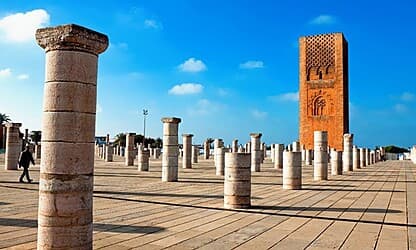
- Mausoleum of Mohammed V — the resting place of the late king, set beside the towering, unfinished Hassan Tower
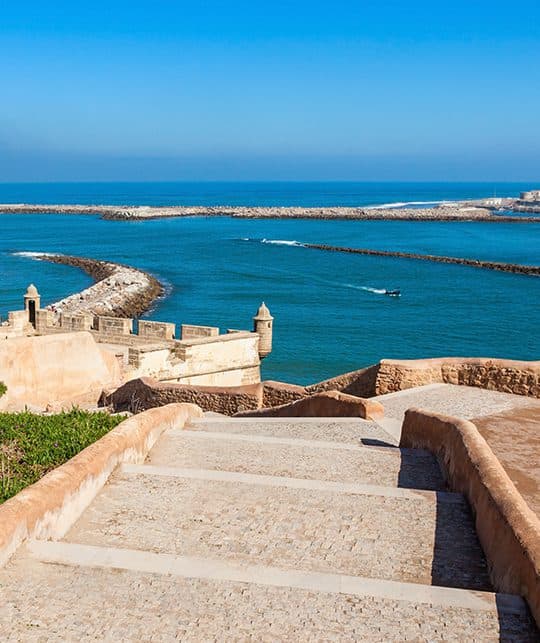
- Kasbah of the Udayas — a fortified blue-and-white quarter perched above the Atlantic at the mouth of the Bou Regreg river
- Andalusian Gardens — a quiet, shaded retreat inside the Kasbah, planted with orange trees and fragrant flowers
- Chellah — an ancient necropolis just outside the walls, where Roman ruins sit beneath a medieval Islamic complex
- The medina — a relaxed, walkable old town that feels far less overwhelming than Marrakech's or Fes's
Together, these sites trace Rabat's arc from a Roman outpost to a medieval stronghold to the seat of the modern Moroccan monarchy. A private guide threads the history between each stop, so the visit reads as one continuous story rather than a checklist of monuments. The walk from the Hassan Tower to the Kasbah to the gardens can be done at a genuinely gentle pace, with time to sit by the river between them.
Timing your dayWhen to visit
Rabat is best visited on a weekday, when government and royal sites are quieter and easier to move through at a relaxed pace. Spring and fall bring the most comfortable temperatures for walking the Kasbah's alleyways and the gardens. Because the city is well organized and easy to navigate with a private driver, it fits neatly into a longer route alongside Fes, Meknes, and the Blue City. Travelers often pair it with a private Chefchaouen tour when heading north.
The case for RabatWhy it is worth the stop
Travelers who skip Rabat in favor of Marrakech and Fes miss a side of Morocco that is easy to overlook: the country's political present, not just its historic past. A private Rabat tour is a calm, walkable counterpoint to the intensity of the souks further south, and it rounds out an itinerary with real depth. It pairs especially well with a guided walk through the Fes medina, and it belongs on any shortlist of Morocco's must-visit cities. For travelers who want the full sweep from imperial capitals to the dunes, our overview of the imperial cities and the Sahara shows how Rabat opens a longer journey.
Where it fitsPrivate tours through the imperial cities
Every Gateway2Morocco journey is 100 percent private, led by government-licensed guides and shaped around your dates and interests. Founded by Brahim Jounh, born in Agoudal, a Berber village in Morocco's High Atlas, and now based in Canada, we have guided North American travelers across the kingdom with a 4.9-star rating on TripAdvisor and more than 300 reviews. The itineraries below build Rabat into a fuller route through Morocco's imperial cities.
A written proposal within 48 hours — no deposit, unlimited revisions.
Begin your journey